By Eric Dawson September 28, 2026
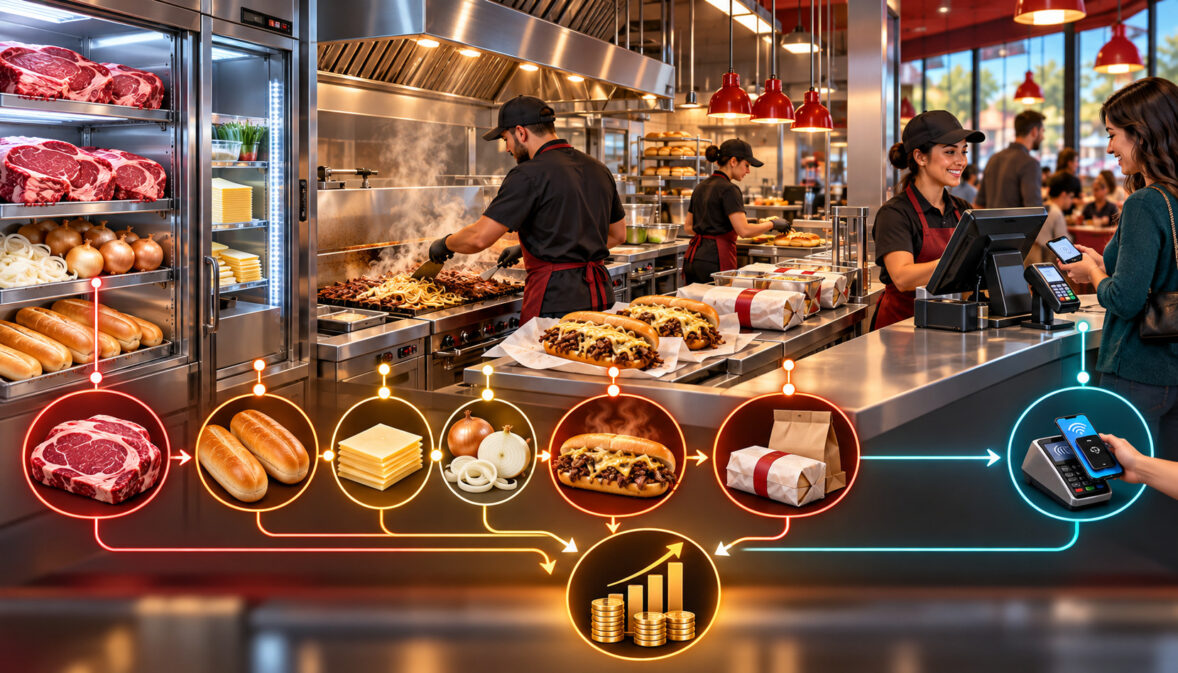
The cost to open a cheesesteak shop depends heavily on whether you take over a restaurant-ready location or convert a space that needs new kitchen infrastructure. The useful approach is to model buildout and equipment separately from ribeye cost, labor, occupancy, checkout expenses, and the daily transaction volume required to support the store.
Four variables usually dominate the economics: restaurant-ready infrastructure versus major construction, meat and ingredient cost, labor productivity around the griddle, and transaction volume relative to fixed overhead.
That is why the cost to run a cheesesteak shop should never be reduced to one nationwide startup figure. Two operators can buy similar griddles and slicers yet face completely different opening budgets because one inherits a workable hood, refrigeration, plumbing, electrical capacity, and fire protection while the other starts with an ordinary retail shell.
The better question is not simply, “How much cash does the opening take?” It is:
What does one sellable cheesesteak cost, how much contribution does each order create, and how many orders must leave the counter every day before the location pays its bills?
Cost to Open a Cheesesteak Shop: The Numbers You Actually Need to Model
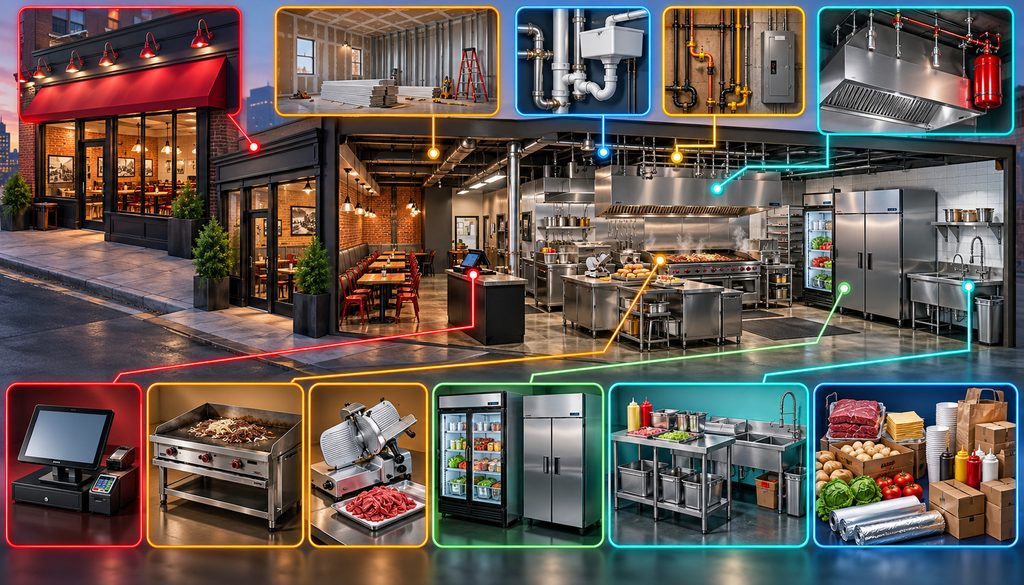
When estimating the cost to open a cheesesteak shop, separate startup spending from the economics of each sale. The U.S. Small Business Administration’s break-even framework uses fixed costs, selling price, and variable cost per unit to determine how many units a business must sell, which translates naturally to a cheesesteak shop’s rent, food, packaging, transaction costs, labor assumptions, and sandwiches sold.
| Cost bucket | What belongs here | One-time or recurring? | Biggest variable |
| Site control | Security deposit, prepaid rent, legal review | Mostly one-time | Lease terms |
| Design/engineering | Architect, kitchen plans, engineering where required | One-time | Existing conditions and jurisdiction |
| General buildout | Walls, flooring, counters, finishes | One-time | Restaurant-ready vs shell space |
| Electrical | Panels, circuits, equipment connections | Mostly one-time | Existing capacity |
| Plumbing/drainage | Sinks, drains, water, waste lines | Mostly one-time | Existing infrastructure |
| Gas service | Service, piping, appliance connections where used | Mostly one-time | Available capacity |
| Cooking exhaust | Hood, duct, fan, makeup air, roof work | One-time + maintenance | Cooking process and existing system |
| Fire protection | Cooking-system suppression and related modifications | One-time + service | Appliance arrangement/local code |
| Cooking equipment | Griddle, fryer, hot holding | One-time | Capacity and specification |
| Cold storage | Walk-in/reach-in refrigeration and freezer | One-time + repairs | Existing usable equipment |
| Prep equipment | Slicer, prep refrigeration, tables | One-time | Prep method |
| Warewashing/sanitation | Required sinks and related equipment | One-time | Local requirements/layout |
| Checkout | POS, terminal, printers/KDS, cash drawer | One-time + recurring | Software and hardware model |
| Regulatory | Health, building, fire and business approvals | Both | Jurisdiction |
| Opening inventory | Beef, rolls, cheese, beverages, packaging | Replenishing | Opening volume |
| Insurance | Required coverage | Recurring | Market and risk profile |
| Working capital | Rent, payroll, food and bills during ramp | Opening reserve | Ramp period |
This is why the cost to run a cheesesteak shop cannot be calculated from an equipment list alone.
Restaurant-ready space versus ordinary retail space
A former restaurant may already contain valuable infrastructure: an exhaust route, approved hood, grease-handling arrangements, plumbing, floor drains, suitable electrical service, gas capacity, refrigeration, sinks, washable surfaces, or an existing fire-suppression installation.
Do not assume those systems are usable simply because they are present. Their condition, capacity, listing, placement, permits, and compatibility with the proposed equipment still need to be checked with the appropriate local authority and qualified contractors.
A cheap nonrestaurant lease can become an expensive restaurant project once the kitchen design reveals that the property needs substantial mechanical, electrical, plumbing, roofing, or structural work.
That is why experienced operators investigate the building before they become emotionally attached to the rent.
A Practical Cheesesteak Shop Equipment List
A useful cheesesteak shop equipment list starts with production capacity rather than a shopping catalog.
Equipment should answer four questions:
- How much product can the station produce?
- What infrastructure does it require?
- What station becomes the bottleneck during a rush?
- Can it be serviced quickly when it fails?
| Equipment | Why it matters | New, used, or either? | What changes the cost |
| Commercial flat-top griddle | Primary steak/onion production | Either | Width, plate, controls, duty cycle |
| Type I hood where required | Grease/smoke exhaust | Site-specific installation | Length, airflow, duct route |
| Fire-suppression system | Cooking-line protection | Qualified installation/service | Appliance layout and adopted requirements |
| Walk-in or reach-in refrigerator | Beef and ingredient storage | Either | Capacity, age, condition |
| Freezer | Frozen products/fries where applicable | Either | Capacity and menu |
| Commercial meat slicer | Portion/prep consistency | Either | Duty rating, blade and motor |
| Prep refrigerator | Fast access on line | Either | Length and pan capacity |
| Stainless prep tables | Portioning and assembly | Either | Size and gauge |
| Sinks | Handwashing, warewashing, prep as required | Usually site-specific | Local rules and plumbing |
| Hot-holding equipment | Holds appropriate items safely | Either | Production model |
| Fryer | Fries and fried sides | Either | Oil capacity and exhaust load |
| Beverage equipment | Drinks | Buy/lease/vendor dependent | Fountain vs packaged beverages |
| Shelving/storage | Dry goods and disposables | Either | Kitchen footprint |
| POS/register | Order entry, payment, reporting | Current supported equipment | Software/payment architecture |
| Kitchen printer/KDS | Sends orders to production | Usually new/current hardware | Number of stations |
| Smallwares | Spatulas, knives, pans, scales, tongs | Mostly new | Volume and menu |
Equipment also explains only part of the cost to open a cheesesteak shop. The installed cost of a cook line depends on what the building has to provide around those appliances.
Why the hood can matter more than the griddle
Commercial cooking that produces grease-laden vapors can trigger substantial exhaust and fire-protection requirements under the locally adopted codes and standards.
Commercial cooking ventilation is not just an equipment-purchase issue. NFPA 96 addresses ventilation control and fire protection for commercial cooking operations, including hoods, grease-removal equipment, exhaust systems, air movement, and fire-protection components. The locally adopted code and the authority having jurisdiction still control what a particular cheesesteak shop must install.
That distinction matters.
The griddle may be a relatively straightforward purchase. The hood, duct route, exhaust fan, makeup air, suppression modifications, utility connections, roof penetrations, and construction around it can become the consequential part of the project.
Current restaurant-supply listings show how widely commercial griddle prices can vary by size, controls, plate construction, and duty rating.
For example, a 36-inch Vulcan VCRG36-M1 natural-gas countertop griddle was listed at $2,501 when checked on September 27, 2026, while comparable commercial models can cost substantially more depending on specification and manufacturer.
The same dealer’s current griddle listings included models ranging from below $1,000 to many thousands of dollars depending on brand, controls, plate configuration, and duty level.
That demonstrates why “commercial griddle cost” is not a single useful number.
A slicer creates the same issue. A light- or medium-duty machine and a high-volume production slicer are not interchangeable just because both have 12-inch blades.
Buy for the workload.
The Ribeye Math: What One Cheesesteak Really Costs to Make
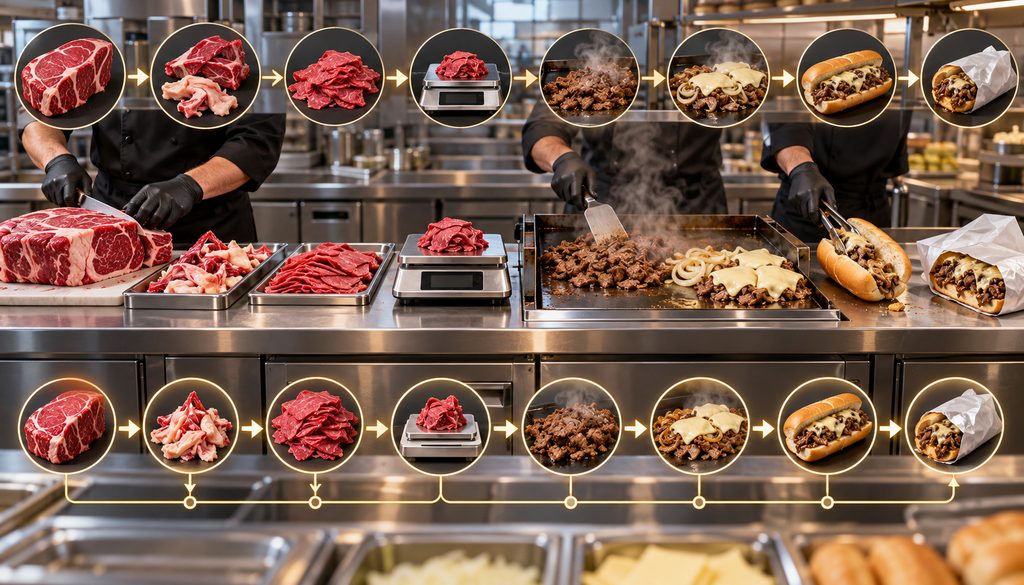
The cost to open a cheesesteak shop determines whether you can reach opening day. The ribeye math helps determine whether the business can survive after it.
Food cost should begin at purchasing, not at menu pricing.
A useful model tracks:
- purchased meat weight
- trim or unusable loss
- usable prepared weight
- portion ounces
- roll
- cheese
- standard vegetables
- oil
- seasoning
- condiments
- packaging
- routine waste
If your meat has measurable trimming or preparation loss:
Usable meat cost per pound = purchase cost per pound ÷ usable yield percentage
Then:
Meat cost per sandwich = usable meat cost per pound × portion weight in pounds
Since there are 16 ounces in a pound:
Portion weight in pounds = meat ounces ÷ 16
Illustrative cheesesteak food-cost example
The following numbers are hypothetical modeling assumptions. They are not current wholesale ribeye quotes, recommended portions, or industry averages.
Assume:
- Beef purchase cost: $8.00/lb.
- Illustrative usable yield: 90%
- Roll: $0.75
- Cheese: $0.55
- Onions/oil/seasoning/condiments: $0.35
- Wrapper or container plus napkins: $0.30
- Additional modeled waste allowance: $0.20
The usable meat cost becomes:
$8.00 ÷ 0.90 = $8.89 per usable pound
Now compare two portions.
A 7-ounce portion equals:
7 ÷ 16 = 0.4375 lb.
Meat cost:
$8.89 × 0.4375 = about $3.89
A 10-ounce portion equals:
10 ÷ 16 = 0.625 lb.
Meat cost:
$8.89 × 0.625 = about $5.56
| Cost component | Illustrative 7 oz | Illustrative 10 oz |
| Beef | $3.89 | $5.56 |
| Roll | $0.75 | $0.75 |
| Cheese | $0.55 | $0.55 |
| Toppings/oil/condiments | $0.35 | $0.35 |
| Packaging | $0.30 | $0.30 |
| Waste allowance | $0.20 | $0.20 |
| Modeled variable product cost | $6.04 | $7.71 |
The 3-ounce increase adds roughly $1.67 in meat cost under these assumptions.
If the shop produces 200 sandwiches in a day, uncontrolled portion creep can therefore matter quickly.
Purchased weight, usable weight, and service yield are different
Do not automatically apply a yield percentage downloaded from somebody else’s restaurant spreadsheet.
Fresh whole-muscle ribeye may involve different trimming and slicing labor than frozen pre-portioned product. Pre-sliced restaurant-supply beef may have a different purchase price but reduce prep time and portion variation.
Measure the product you actually buy.
For each case or primal:
Yield percentage = usable prepared weight ÷ purchased weight
If you buy 40 pounds and obtain 37 pounds that can actually be portioned for service:
37 ÷ 40 = 92.5% usable yield
That is a measurement of that specific test—not a universal ribeye-yield claim.
Use repeated tests rather than one unusually clean or unusually wasteful case.
When building the recipe-cost model, treat ribeye, rolls, cheese, onions, and other cheesesteak ingredients as separate cost inputs rather than one combined food-cost number. Each component should have its own purchase unit, usable yield where relevant, portion standard, and current supplier cost.
Pricing a Cheesesteak Against a Target Food-Cost Percentage
A common planning formula is:
Required menu price = food cost per sandwich ÷ target food-cost percentage
Suppose the modeled variable food/packaging cost is $6.50.
| Food cost per sandwich | 25% scenario | 28% scenario | 30% scenario | 33% scenario |
| $5.50 | $22.00 | $19.64 | $18.33 | $16.67 |
| $6.50 | $26.00 | $23.21 | $21.67 | $19.70 |
| $7.50 | $30.00 | $26.79 | $25.00 | $22.73 |
These are scenario targets, not a claim that every sandwich shop should operate at 25%, 28%, 30%, or 33%.
The right answer depends on the entire menu and cost structure.
Food-cost percentage is not profit
Suppose Shop A sells a sandwich for $15 with $4.50 of food and packaging.
Food cost:
$4.50 ÷ $15 = 30%
Suppose Shop B sells a larger sandwich for $20 with $6.20 of food and packaging.
Food cost:
$6.20 ÷ $20 = 31%
Shop B has the higher food-cost percentage, but it has $13.80 left before its other variable costs, versus $10.50 for Shop A.
Percentage alone does not tell you which transaction contributes more dollars toward occupancy and labor.
That leads to the more useful calculation:
Contribution per transaction = selling price − variable food/packaging − other variable transaction costs
If your accounting model treats a portion of hourly labor as directly variable with volume, include that variable labor component as well.
Contribution then pays for costs such as:
- occupancy
- management
- utilities
- insurance
- software
- maintenance
- pest control
- cleaning
- bookkeeping
- marketing
- debt service
- owner compensation
- taxes
Griddle Line Labor Costs: How Many People Does the Shop Actually Need?
Do not begin with a generic labor percentage.
Begin with stations, demand, and hourly output.
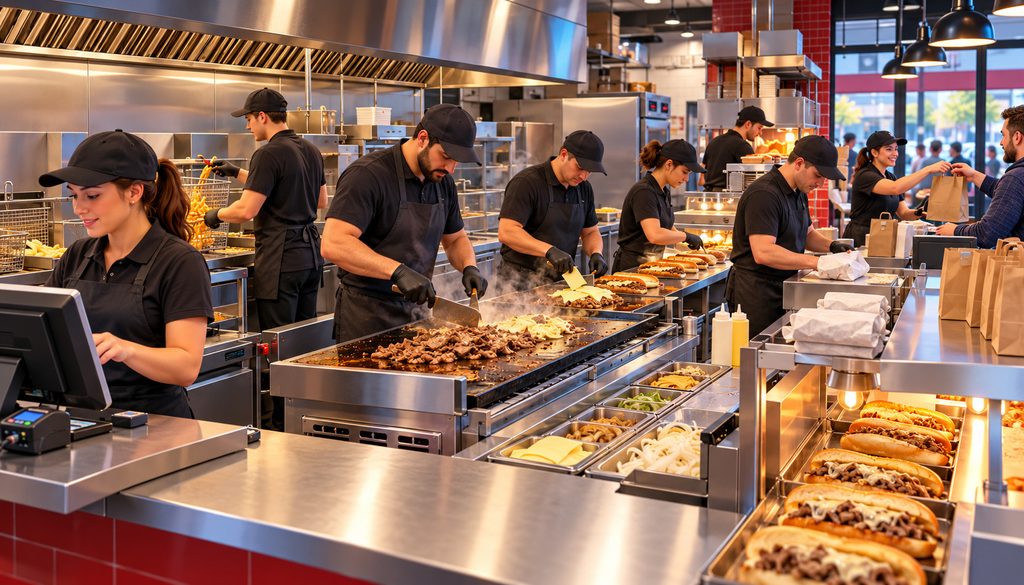
A cheesesteak line may contain:
- register/order entry
- primary grill cook
- second grill/chop/cheese position
- fry station
- finishing and wrapping
- expo
- pickup/delivery handoff
- prep/dish
- manager
One employee can cover multiple positions when demand is low. During a rush, combining too many functions can cause queues, ticket errors, and slow handoff.
Low-volume off-peak line
A small operation may use one or two cross-trained employees across order entry, cooking, finishing, restocking, and cleaning.
That configuration should be evaluated by actual orders per 15-minute interval—not by wishful scheduling.
Normal lunch or dinner rush
As volume increases, separating register, griddle, finishing, and handoff may increase throughput enough to justify the additional labor.
The question is not “How few people can operate the restaurant?”
The better question is:
What staffing configuration maximizes contribution dollars without sacrificing service or product consistency?
Event, game-day, or heavy catering volume
High-volume periods may justify dedicated fry, grill, wrapping, expo, pickup, and replenishment functions.
Large orders affect kitchen capacity differently from ordinary walk-in traffic. When customers are planning cheesesteak quantities for a party or game night, dozens of sandwiches may need to leave the line within one pickup window, so the operator has to account for that production block when scheduling grill, fry, wrapping, and expo labor.
For the operator, that means catering or game-day volume needs to be scheduled into the production plan rather than simply added to normal counter traffic.
Calculate labor per sandwich
Use:
Hourly labor cost = employees scheduled × loaded hourly labor cost
Then:
Labor dollars per sandwich = hourly labor cost ÷ sandwiches produced during that hour
Illustrative example:
Four employees × hypothetical $24 loaded hourly cost:
4 × $24 = $96/hour
If they produce 80 sandwiches:
$96 ÷ 80 = $1.20 labor per sandwich
If they produce only 30:
$96 ÷ 30 = $3.20 labor per sandwich
Same crew. Same hourly payroll. Very different unit economics.
What does “loaded labor” include?
Do not use wage alone.
Depending on the employer and jurisdiction, loaded labor can include:
- cash wage
- employer payroll taxes
- unemployment taxes
- workers’ compensation
- paid leave
- health or other benefits
- payroll-related costs
Use your actual employer cost.
For context only, not as a wage recommendation, U.S. Bureau of Labor Statistics May 2025 national medians were $15.00 per hour for fast-food and counter workers, $17.98 for restaurant cooks, and $21.19 for first-line supervisors of food preparation and serving workers. Actual labor markets vary substantially by city and state.
That is why a national wage figure should never be copied directly into a store budget.
The Volume Math: How Many Sandwiches a Day Cover the Bills?
Anyone calculating the cost to open a cheesesteak shop should run the break-even calculation before signing the lease.
Opening capital answers:
Can I build it?
Break-even analysis answers:
If I build it, how much business must the store produce every month?
Revenue break-even versus contribution break-even
Revenue alone is not enough.
If you sell a $20 order but incur $8 of costs that rise with that order, you do not have $20 available to pay rent.
The core formula is:
Break-even units = fixed operating costs ÷ contribution per unit
This is consistent with the SBA break-even framework:
Fixed costs ÷ (selling price − variable cost per unit)
Illustrative Shop Scenario
Consider a hypothetical takeout-focused cheesesteak shop that leases a former restaurant with an existing hood and walk-in.
These are deliberately hypothetical assumptions:
- 30 operating days per month
- Average ticket: $18.50
- Food and packaging per average transaction: $6.25
- Variable payment cost assumption: $0.55
- Variable line-labor allocation: $3.00
- Contribution per transaction: $8.70
- Monthly fixed overhead after that variable-labor allocation: $25,000
Contribution:
$18.50 − $6.25 − $0.55 − $3.00 = $8.70
Monthly break-even transactions:
$25,000 ÷ $8.70 = approximately 2,874
Daily break-even:
2,874 ÷ 30 = approximately 96 transactions per day
| Transactions/day | Illustrative average ticket | Monthly sales at 30 days | Contribution available for fixed costs |
| 75 | $18.50 | $41,625 | $19,575 |
| 100 | $18.50 | $55,500 | $26,100 |
| 125 | $18.50 | $69,375 | $32,625 |
| 150 | $18.50 | $83,250 | $39,150 |
At 75 transactions, this hypothetical shop would not cover the modeled $25,000 fixed-cost figure.
Around 96 transactions is mathematical break-even under the assumptions.
At 125 or 150 transactions, contribution exceeds the modeled fixed overhead—but that is not automatically owner take-home profit. Taxes, debt treatment, capital purchases, accounting classifications, and other cash needs still matter.
Average ticket changes the equation
Two stores selling the same number of cheesesteaks can produce different revenue and contribution because one sells mostly sandwich-only tickets while the other sells:
- fries
- fountain drinks
- bottled beverages
- premium cheese
- mushrooms or peppers
- extra meat
- combo meals
- catering packages
Add-ons should be measured by contribution dollars, not simply by a belief that “drinks have good margins.”
A profitable side program helps.
It does not fix a sandwich that is badly underpriced or a lease the concept cannot support.
Fixed Costs That Keep Running When the Griddle Is Slow
A packed noon hour can hide an expensive afternoon.
Recurring cheesesteak shop operating costs may include:
- rent
- CAM or other occupancy charges
- management payroll
- base staffing
- electricity
- gas
- water/sewer
- insurance
- grease service
- pest control
- hood/exhaust cleaning
- waste removal
- equipment repair
- refrigeration service
- software
- internet and phone
- accounting/bookkeeping
- cleaning products
- permit/license renewals
- music licensing where applicable
- merchant-account/POS costs
- financing payments
- marketing
- linen service where used
Some costs are mixed rather than perfectly fixed.
Power consumption, labor, maintenance, and supplies may increase with volume while still containing a base component.
That distinction matters when modeling the cost to open a cheesesteak shop, because startup capital should include enough working cash to carry recurring expenses while sales develop.
Opening day does not end the startup phase.
The Register Matters More Than It Looks
Checkout is a production station.
A sandwich shop may need:
- touchscreen POS
- customer-facing display
- payment terminal
- contactless acceptance
- cash drawer
- receipt printer
- kitchen printer or KDS
- online ordering
- pickup routing
- modifier logic
- menu management
- reporting
- reconciliation
- handheld/line-busting device where useful
A slow register can waste grill capacity.
A poorly configured modifier screen can send incorrect tickets to the line.
An online-order system that does not pace orders against kitchen capacity can bury the grill during the same rush when the front counter is already full.
Card acceptance is a variable cost
Do not insert a made-up “standard processing rate.”
Actual cost depends on the merchant agreement, pricing structure, card mix, transaction amounts, acceptance channels, gateway/software charges, and other contract terms.
Calculate what you actually pay:
Effective card cost = total processing fees ÷ total card sales
Then compare checkout systems based on the total stack:
POS software + ordering software + hardware + integrations + payment cost
Do not evaluate the payment rate in isolation.
Payment security belongs in the checkout decision
PCI DSS applies to entities that store, process, or transmit cardholder data or can affect the security of the cardholder-data environment. PCI SSC also states that payment terminals involved in processing card data are within PCI scope, with applicable controls depending on the device and environment.
That does not mean every cheesesteak shop has the same PCI validation scope.
The merchant should confirm its actual validation obligations with the party responsible for its compliance program, such as its acquirer or payment brand.
Speed at the Window Is a Unit-Economics Variable
A cheesesteak line is a series of connected capacity limits.
Important stations include:
- ordering
- meat staging
- griddle
- cheese/melt process
- fries
- bread and finishing
- wrapping
- bagging
- labeling
- expo
- pickup
The useful framework is:
Hourly sales capacity = capacity of the slowest critical station
Suppose:
- register can enter 100 orders/hour
- griddle can support 85 sandwiches/hour
- fryer can support side demand associated with 70 orders/hour
- finishing/wrapping can handle 55 sandwiches/hour
If finishing cannot reliably exceed 55, the practical sandwich capacity may be near 55 even though the griddle itself could cook more.
A bigger griddle would not solve that bottleneck.
The operator should first ask:
Which station prevents the next completed order from leaving?
Measure throughput in short intervals
Daily sales are too blunt for rush diagnostics.
Track:
- orders per 15 minutes
- sandwiches per 15 minutes
- sandwiches per grill labor hour
- ticket time
- orders waiting at expo
- abandoned/cancelled orders where measurable
- modifier errors
- remake rate
A 90-minute lunch rush can determine a large portion of the day’s economics.
Treat those 90 minutes like a production window.
What Sandwich Shop Profit Margins Actually Mean
Avoid statements such as “sandwich shops average X% profit” unless the calculation and population are clearly defined.
“Margin” can describe very different numbers.
| Margin term | What it actually measures |
| Gross food margin | Revenue remaining after defined food/product costs |
| Contribution margin | Revenue remaining after defined variable costs |
| Store-level operating margin | Store revenue minus ordinary store operating expenses |
| EBITDA-style operating result | Earnings before defined interest, tax, depreciation and amortization |
| Owner compensation | Pay or distributions received by owner |
| Cash flow after debt | Cash after required financing payments |
One operator may include the owner’s salary in labor.
Another may treat owner compensation separately.
One business may have no debt.
Another may carry heavy equipment and buildout financing.
One may rely heavily on third-party delivery.
Another may run mostly direct pickup.
Those shops can show similar food-cost percentages while producing completely different cash outcomes.
Do not evaluate sandwich shop profit margins without asking what was deducted before the percentage was calculated.
Where New Cheesesteak Shops Overspend in Year One
1. Taking a cheap lease that needs expensive mechanical work
Investigate hood, exhaust, utilities, plumbing, drainage, roof access, and permitted use before treating rent as a bargain.
2. Oversizing the dining room
If the business model is predominantly takeout and delivery, unused seats still consume rent, utilities, cleaning time, and buildout dollars.
3. Buying every piece of equipment new
Compare new and professionally evaluated used options based on reliability, parts availability, warranty, sanitation condition, and remaining service life.
4. Buying too little griddle
Peak demand—not average hourly volume—should inform grill capacity.
5. Buying too much griddle
Oversized equipment consumes capital and kitchen space and may increase infrastructure requirements without producing another transaction.
6. Carrying too many SKUs
Every additional meat, cheese, bread, sauce, and side creates purchasing, storage, prep, training, spoilage, and inventory complexity.
7. Ignoring trim, spoilage, and overportioning
A theoretical recipe cost is useless if actual kitchen usage consistently exceeds it.
Compare expected usage with actual purchases.
8. Copying a competitor’s menu price
You do not know its rent, volume, purchasing terms, meat portion, debt load, or labor productivity.
Price from your own economics.
9. Scheduling rush labor during slow periods
Build schedules around actual 15- and 30-minute demand patterns.
10. Paying for overlapping software
POS, online ordering, delivery middleware, loyalty, payroll, scheduling, and marketing systems can quietly create a significant recurring technology bill.
11. Underestimating working capital
A shop can complete its buildout and still fail because it runs short of cash during the sales ramp.
12. Spending on decor before mechanical reliability
A refrigeration or ventilation problem can stop production. An ordinary wall finish usually cannot.
13. Signing long equipment contracts without comparing total cost
Compare the total contractual obligation, service terms, ownership provisions, and early-termination terms—not just the monthly payment.
14. Treating processing cost as the only checkout cost
Measure the whole technology and payments stack.
15. Opening without measuring sandwiches per labor hour
If you cannot connect labor hours to production volume, scheduling becomes guesswork.
A Simple Opening Budget Model
The most credible way to estimate the cost to open a cheesesteak shop is to obtain quotes for the actual property rather than filling a spreadsheet with national restaurant averages.
| Cost category | Low-complexity scenario | Higher-complexity scenario | Your actual quote |
| Lease/deposit | Market-dependent | Market-dependent | $_____ |
| Architecture/engineering | Scope-dependent | Significant plan/design work | $_____ |
| General construction | Existing restaurant | Major conversion | $_____ |
| Hood/exhaust | Existing system verified | New engineered system | $_____ |
| Fire suppression | Existing system verified | New/modified system | $_____ |
| Gas | Existing capacity | Service/piping changes | $_____ |
| Electrical | Existing capacity | Panel/service work | $_____ |
| Plumbing/drainage | Minor adaptation | Major modifications | $_____ |
| Griddle | Vendor quote | Vendor quote | $_____ |
| Fryer | Menu-dependent | Menu-dependent | $_____ |
| Refrigeration | Verified existing equipment | New/replacement equipment | $_____ |
| Slicer | Vendor quote | Vendor quote | $_____ |
| Prep equipment | Vendor quote | Vendor quote | $_____ |
| Smallwares | Menu/volume dependent | Menu/volume dependent | $_____ |
| POS/KDS | Vendor quote | Expanded system | $_____ |
| Signage/menu boards | Local/vendor quote | Local/vendor quote | $_____ |
| Permits/approvals | Local authority | Local authority | $_____ |
| Opening inventory | Supplier quotes | Supplier quotes | $_____ |
| Insurance | Broker quote | Broker quote | $_____ |
| Pre-opening payroll | Hiring plan | Hiring plan | $_____ |
| Working capital | Cash-flow model | Longer ramp reserve | $_____ |
Do not let the “low-complexity” column become a promise that a former restaurant will be inexpensive.
Inspection can uncover failed refrigeration, obsolete systems, insufficient utilities, or equipment that does not fit the new layout.
A Cheesesteak Unit-Economics Worksheet
Use this worksheet before opening and keep using it after opening.
| Variable | Input or formula |
| Beef purchase cost/lb. | $_____ |
| Purchased beef weight | _____ lb. |
| Usable beef weight | _____ lb. |
| Usable yield | usable ÷ purchased |
| Usable beef cost/lb. | purchase price ÷ usable yield |
| Meat ounces/sandwich | _____ oz. |
| Portion pounds | ounces ÷ 16 |
| Meat cost/sandwich | usable cost/lb. × portion pounds |
| Roll cost | $_____ |
| Cheese cost | $_____ |
| Standard toppings | $_____ |
| Oil/seasoning/condiments | $_____ |
| Packaging | $_____ |
| Waste allowance | $_____ |
| Variable product cost | sum above |
| Menu price | $_____ |
| Variable payment cost | $_____ |
| Other variable cost | $_____ |
| Contribution/transaction | selling price − variable costs |
| Sandwiches/hour | _____ |
| Loaded labor/hour | $_____ |
| Labor/sandwich | labor/hour ÷ sandwiches/hour |
| Monthly fixed costs | $_____ |
| Operating days | _____ |
| Break-even units/month | fixed costs ÷ contribution |
| Break-even units/day | monthly units ÷ operating days |
Add actual-versus-theoretical food cost
After opening, compare theoretical recipe usage with actual purchasing and inventory movement.
If recipe cards say you should have consumed 700 pounds of beef but inventory and purchasing indicate 780 pounds left storage during the same sales period, investigate:
- portions
- trim
- waste
- spoilage
- remakes
- employee meals
- inventory errors
- unrecorded sales
A food-cost spreadsheet should reveal operating problems, not merely predict them.
Before You Sign the Lease: A 10-Step Cheesesteak Shop Cost Check
A large part of the cost to open a cheesesteak shop can be discovered before the lease becomes binding.
1. Confirm zoning and approved restaurant use
Ask the local zoning/building authority whether the intended operation is allowed and what approvals precede construction.
2. Determine what hood and exhaust system the menu requires
Document the proposed cooking equipment and have the applicable professionals and local authority evaluate the exhaust requirement.
Do not rely on “there’s already a hood.”
3. Verify gas, electric, plumbing, drainage, and fire-protection capacity
Match utility capacity to actual equipment specifications.
4. Measure usable production capacity
Do not measure only square footage.
Measure grill width, refrigeration access, finishing space, fryer capacity, prep space, and handoff space.
5. Price the exact beef specification
Get supplier quotes for the product you intend to use.
Do not budget grocery-store prices if that is not your purchasing channel.
6. Run several yield and portion tests
Model 7-ounce, 8-ounce, 10-ounce, or whichever portions are actually being considered.
Then perform real yield tests.
7. Build labor by daypart
Estimate staff required at opening, prep, lunch, afternoon, dinner, close, and event peaks.
8. Price checkout as one operating system
Combine POS, online ordering, KDS/printers, hardware, integrations, and card acceptance.
9. Calculate break-even volume
Convert fixed overhead into required transactions per month and per operating day.
Then ask whether the kitchen can physically produce that volume during the hours customers actually buy.
10. Hold working capital for the ramp
Do not spend every available dollar reaching opening day.
Build a cash-flow model for payroll, rent, inventory, repairs, utilities, and debt during the sales ramp.
FAQs
How much does it cost to open a cheesesteak shop?
There is no responsible nationwide figure for the cost to open a cheesesteak shop because the building can change the result dramatically.
A restaurant-ready site with usable exhaust, plumbing, electrical capacity, cold storage, sinks, and fire protection presents a very different project from a plain retail shell. Build the estimate from property-specific contractor quotes, actual equipment specifications, local approvals, opening inventory, pre-opening expenses, and working capital.
What is usually the biggest startup expense for a cheesesteak restaurant?
It may be the buildout and mechanical infrastructure rather than one piece of kitchen equipment.
New ventilation, ductwork, makeup air, utility upgrades, plumbing, construction, roof work, and fire protection can substantially change a project. The actual scope must be determined for the specific location and menu.
How much ribeye goes into a cheesesteak?
There is no universal portion that every shop must use.
Choose the portion that matches the product concept, then convert ounces to pounds and multiply by usable meat cost per pound. A 7-ounce portion equals 0.4375 pound; a 10-ounce portion equals 0.625 pound. The important operating control is consistency.
What food-cost percentage should a cheesesteak shop target?
Do not treat one percentage as a universal benchmark.
Model several scenarios, then evaluate whether the resulting menu price is acceptable and whether the contribution dollars remaining after variable costs are sufficient to cover labor, occupancy, and other overhead.
How many employees does a cheesesteak shop need?
Staffing depends on daypart, service method, menu complexity, order volume, and production capacity. A quiet period may allow one or two cross-trained workers to cover several functions. A heavy lunch rush may require separate register, grill, finish, fry, and expo/handoff positions. Measure sandwiches per labor hour rather than copying another restaurant’s headcount.
How many cheesesteaks do I need to sell per day to break even?
Calculate:
Monthly fixed costs ÷ contribution per transaction ÷ operating days
If hypothetical monthly fixed costs are $25,000 and contribution is $8.70 per transaction:
$25,000 ÷ $8.70 = about 2,874 monthly transactions
Over 30 operating days:
about 96 per day
Replace every assumption with your own numbers.
Should I buy used restaurant equipment?
Used equipment can make sense where condition can be properly evaluated and the potential savings justify the risk.
Pay particular attention to refrigeration condition, parts availability, service history, sanitation, electrical or gas specifications, required certifications/listings, installation requirements, and remaining warranty coverage. Cheap equipment that immediately needs major service is not cheap.
What POS system does a cheesesteak shop need?
Start with capabilities rather than brand names.
A practical QSR setup normally needs fast order entry, modifiers, secure card/contactless acceptance, kitchen routing, online-order integration, reporting, reconciliation, menu management, and reliable support.
If rush volume justifies it, also consider handheld ordering or line-busting, multiple production screens, and pickup-management features.
What the Cost to Open a Cheesesteak Shop Really Comes Down To
The cost to open a cheesesteak shop is not one national startup number. It is a chain of property-specific and operating assumptions.
Start with the building.
Confirm that the space can support the cook line you intend to install.
Then calculate the product from the inside out:
beef purchase cost → usable yield → portion cost → total sandwich cost → selling price → variable costs → contribution dollars
After that, connect production to labor:
employees per hour → loaded labor dollars → sandwiches produced → labor dollars per sandwich
Finally, connect the unit economics to the store:
monthly fixed overhead ÷ contribution per transaction = required transactions
Then divide that volume across actual operating days and dayparts.
That is the real test.
A cheesesteak shop can have excellent food and still struggle if its buildout was too expensive, portions drift, the rush line moves slowly, labor stays high during dead periods, or the lease requires more daily volume than the market can produce.
The operator should be able to answer seven questions without guessing:
- What must this specific building cost to make restaurant-ready?
- What does one correctly portioned cheesesteak cost to produce?
- How many sandwiches can each labor hour produce?
- How much contribution does the average transaction generate?
- What station limits peak throughput?
- What does the store cost every month even when the griddle is quiet?
- How many transactions per day are required to cover that overhead?
Once those numbers are real, the cost to open a cheesesteak shop stops being a vague startup estimate and becomes an operating model you can actually manage.