By Eric Dawson September 28, 2026
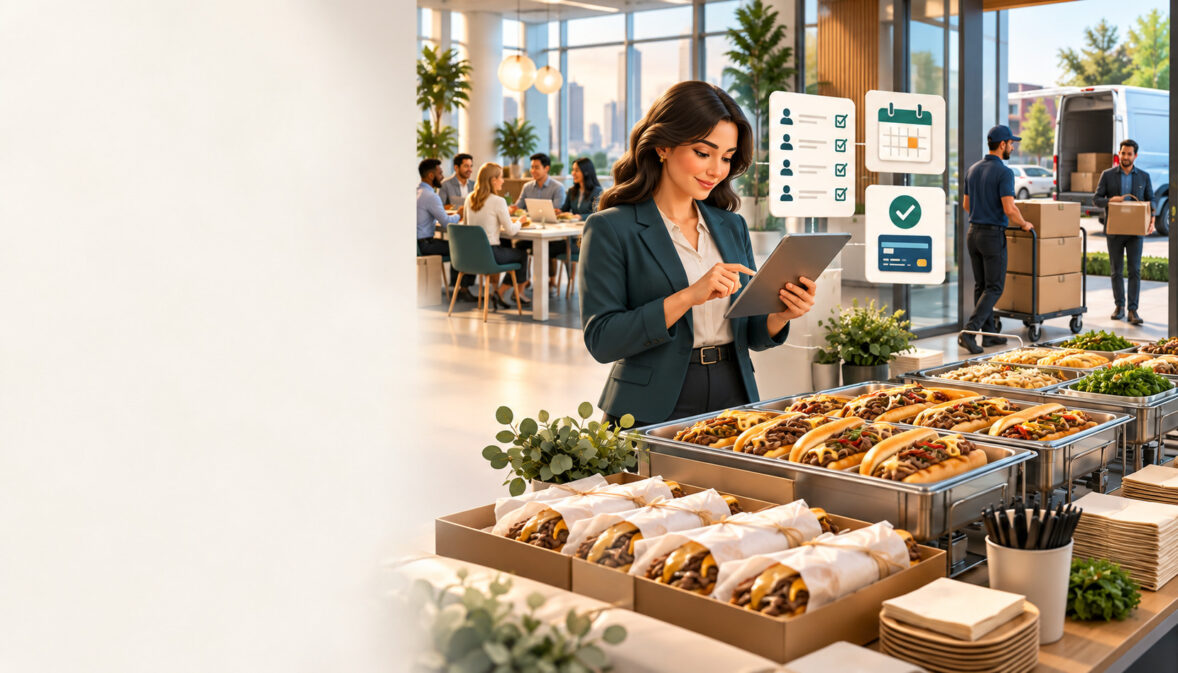
Cheesesteak catering ordering usually starts by estimating the guest count, choosing trays or individual packages, confirming cheese and dietary preferences, reserving the date early, deciding between pickup and delivery, approving any deposit or prepayment requirement, and getting written confirmation of the final quantities, timing, location, customizations, and balance due.
A large catering order involves more than choosing sandwiches. An office manager or event organizer may also need to coordinate serving time, delivery access, payment, dietary requests, labeling, purchase orders, and final headcount changes before the order is ready for production.
The best process is to confirm each operational detail instead of assuming that every large order follows the same rules. Package sizes, delivery availability, deposit requirements, cancellation terms, invoicing, and lead times can all vary by order.
Cheesesteak Catering Ordering: What to Have Ready Before You Call or Order
Efficient cheesesteak catering ordering starts with a complete set of event details. The more information the restaurant has at the beginning, the easier it is to quote the order accurately and identify any timing, delivery, or customization issues before they become problems.
Have the following information ready.
Catering Order Information Checklist
- Event date
- Requested serving time
- Estimated guest count
- Office or event address
- Suite, floor, building, or venue information
- Pickup versus delivery preference
- Preferred sandwich styles
- Approximate cheese split
- Onion and no-onion counts
- Vegetarian requirements
- Serious food-allergy information
- Other dietary requests
- Sides and beverages
- Individually wrapped or shared-service preference
- Meal-labeling needs
- Disposable serving supplies, if needed
- Primary event-day contact
- Backup contact
- Billing contact
- Preferred payment method
- Purchase-order requirement
- Invoice requirement
- Building-security instructions
- Loading-dock or parking information
- Elevator or reception procedures
A request for “lunch for 40 people” is not enough for a reliable catering plan. Forty individually labeled meals delivered through a secured office building at noon require a very different production and delivery workflow from forty sandwiches collected directly by the organizer.
Good cheesesteak catering ordering therefore treats timing, access, payment, customization, and fulfillment as part of the order itself.
Tray and Package Options: How Catering Orders Are Usually Structured
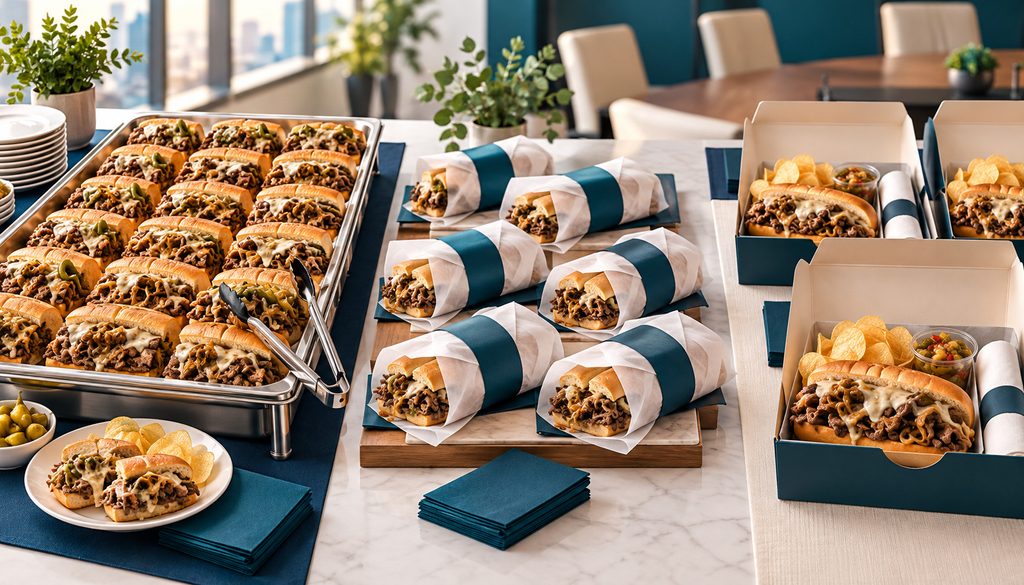
Cheesesteak catering can be organized as shared trays, whole sandwiches, halves, individually wrapped meals, boxed lunches, or mixed packages depending on what is currently available.
The right format depends on how guests will eat, how much customization is required, and how quickly meals need to be distributed.
| Format | Best For | Portion Planning | Serving Convenience | Customization |
| Shared trays | Parties and informal office lunches | Based on stated package yield | Easy buffet service | Moderate |
| Individually wrapped sandwiches | Staff lunches and meetings | Counted individually | Easy distribution | High |
| Boxed lunches | Training sessions and client meetings | Usually per person | Very convenient | High |
| Mixed catering package | Larger events with sides or drinks | Depends on package contents | Convenient for groups | Varies |
| Component-style setup, if available | Casual self-service events | Depends on components supplied | Flexible | Potentially high |
Shared trays are useful when guests are eating together and can serve themselves from one location. Individually wrapped meals are often easier when employees have different preferences or need to take food back to separate work areas.
Boxed meals can be practical for corporate lunch cheesesteak catering because each attendee receives a clearly separated meal. That can simplify distribution in meetings, training sessions, or offices with staggered lunch schedules.
Exact package yield should be confirmed during cheesesteak catering ordering. A “large tray” is not a standardized unit, and its practical serving capacity depends on sandwich size, cutting style, sides, and how the food will be served.
Hosts still working out quantities can use a cheesesteak quantity planning resource for parties and group meals before finalizing the order. Quantity planning should still be separated from the restaurant’s actual catering package yield.
How Many People Does a Cheesesteak Catering Tray Feed?
A cheesesteak catering tray does not have a universal serving yield. The safest approach is to use the restaurant’s stated serving estimate for the specific package instead of assuming that every tray labeled small, medium, or large feeds the same number of people.
The actual yield depends on:
- Full versus half sandwiches
- Sandwich size
- How sandwiches are cut
- Lunch versus appetizer service
- Whether sides are included
- Adult versus mixed-age groups
- Event duration
- Whether cheesesteaks are the only entrée
- Whether other food is available
- Whether guests are likely to take seconds
This is where quantity planning and cheesesteak catering ordering overlap. Quantity planning estimates demand, while catering ordering converts that estimate into an actual package, tray, or sandwich count.
Illustrative Example
An office expects 30 employees for lunch.
If cheesesteaks are the only entrée, the organizer may need a different quantity than if the same group also has salad, pizza, snacks, and dessert available.
That example is only meant to show how menu composition changes demand. It should not be treated as a fixed tray-yield rule.
Catering Lead Times: Next-Day, Same-Week, and Game-Day Orders
Catering lead time depends on order size, complexity, customization, production capacity, delivery requirements, and how busy the requested day is.
Earlier is safer, particularly for larger office lunches, game-day orders, or highly customized requests.
Smaller next-day orders
A next-day order may be easier to accommodate when:
- Quantities are moderate.
- Menu choices are simple.
- Pickup is acceptable.
- Few modifications are required.
- Individual labeling is limited.
- The requested serving time is not during a peak period.
Next-day availability should still be confirmed before the organizer makes promises to attendees.
Same-week office catering
Providing several days of notice where practical gives the kitchen more flexibility for:
- Ingredient planning
- Bread and packaging needs
- Staffing
- Production sequencing
- Labeling
- Delivery scheduling
- Billing paperwork
- Purchase-order processing
- Dietary coordination
A simple bulk pickup is easier to stage than dozens of individually labeled meals requiring multiple cheese selections and office delivery.
Major event and game-day orders
Large event days can place significant pressure on production and delivery capacity. Even when ingredients are available, the preferred serving window can fill quickly.
| Order Situation | Planning Approach | Why |
| Small weekday office lunch | Ask about next-day availability | A simple order may fit normal production |
| Large corporate lunch | Reserve several days ahead when practical | More coordination is required |
| Major event or game day | Contact the restaurant as early as practical | Peak capacity may fill |
| Highly customized order | Allow extra planning time | Modifications increase prep complexity |
Actual availability should always be confirmed.
The catering lead time and deposit should also be discussed together. A quote does not necessarily mean the date is reserved if a payment or authorization step is still required.
When Do Large Catering Orders Require a Deposit or Prepayment?
Large catering orders may require a deposit, partial prepayment, full payment, payment authorization, or written agreement depending on the order.
Restaurants use these arrangements because larger orders can require advance purchasing, dedicated preparation, packaging, delivery staffing, and production capacity that may not be recoverable if the event is canceled late.
Before paying, ask:
- How much is due now?
- When is the remaining balance due?
- What does the payment reserve?
- Is any portion refundable?
- What is the cancellation cutoff?
- How late can the guest count change?
- How are quantity reductions handled?
- How are additions handled?
- What happens if the restaurant cannot fulfill the order?
- Will an updated receipt or confirmation be provided?
Before Paying a Catering Deposit
The confirmation should clearly show:
- Event date
- Pickup or delivery method
- Scheduled fulfillment time
- Delivery location
- Ordered quantity
- Major customizations
- Quoted total
- Amount paid
- Remaining balance
- Balance due date
- Cancellation terms
For a large event, financial terms should never depend on memory alone.
Large Order Pickup vs Delivery: Which Works Better?
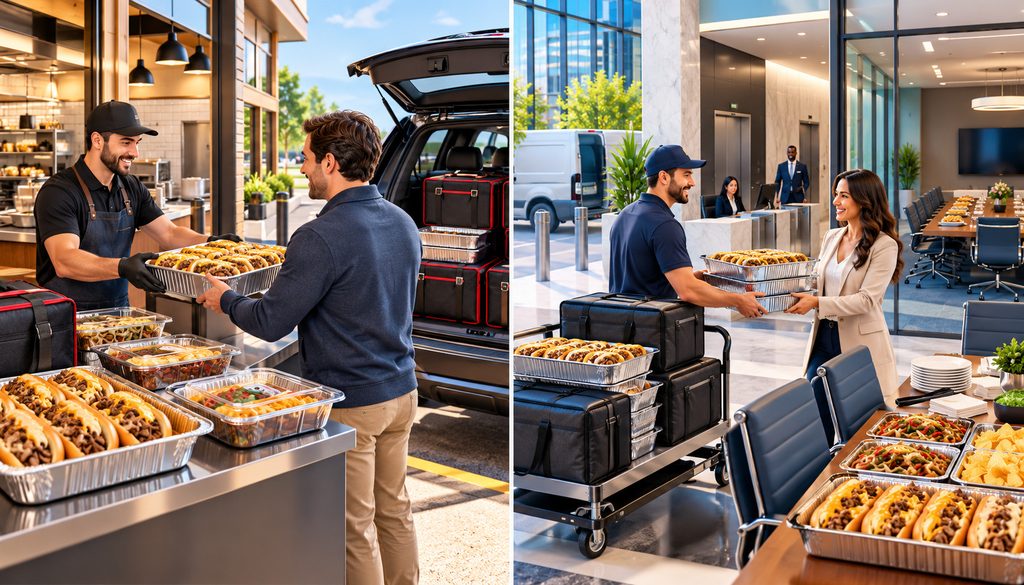
The large order pickup vs delivery decision comes down to convenience, timing, transport capacity, building access, and any delivery-related costs.
Neither option is automatically better.
Pickup advantages
Pickup can work well because it may:
- Give the organizer direct control over collection.
- Work well for nearby offices.
- Avoid reliance on a delivery route.
- Simplify access to difficult venues.
- Potentially reduce delivery-related charges.
Pickup risks
Pickup also transfers transport responsibility to the customer.
Potential problems include:
- Inadequate vehicle space
- Multiple trays shifting during transport
- Food spending too long in transit
- Difficulty carrying several containers
- An employee having to leave the event
- Arriving earlier or later than planned
Delivery advantages
Delivery can reduce disruption for office hosts, especially when several trays or dozens of individually labeled meals are involved.
Delivery considerations
Confirm:
- Whether the address is eligible
- Any order minimum
- Delivery window
- Parking access
- Loading-dock requirements
- Building security
- Reception procedure
- Elevator access
- Office floor or suite
- On-site contact
- Where the handoff occurs
- Whether setup is included
- Any applicable charges
| Factor | Pickup | Delivery |
| Cost considerations | May avoid delivery-related charges | Additional charges may apply |
| Timing control | Customer controls collection | Depends on delivery routing |
| Transport responsibility | Customer | Restaurant or delivery provider |
| Office convenience | Lower | Usually higher |
| Large-order practicality | Vehicle capacity may become limiting | Often easier if available |
| Setup | Customer handles it | Must be confirmed separately |
For general fulfillment planning, pickup and delivery considerations for cheesesteak orders can help explain the practical differences between collecting food and having it brought to the destination.
Large catering delivery should still be confirmed for the actual address, event time, and order size.
Delivery Radius, Setup, and Keeping Cheesesteaks Ready to Serve
Catering delivery involves more than determining whether a restaurant can reach the address. Organizers also need to know where the delivery ends and what happens after the food enters the building.
During cheesesteak catering ordering, ask whether delivery means:
- Curbside handoff
- Lobby delivery
- Reception-desk delivery
- Delivery to the office suite
- Basic food placement
- Additional setup, if offered
Do not assume that warming equipment, plates, napkins, utensils, serving tongs, chafing equipment, table coverings, or buffet setup are included unless specifically confirmed.
Cheesesteaks are also sensitive to timing from an eating-quality standpoint. Bread, meat, cheese, steam, and wrapping continue interacting after the sandwich leaves the cooking surface.
Practical event-day steps include:
- Schedule arrival close to serving time.
- Prepare the serving area in advance.
- Assign one person to receive the food.
- Check the number of trays or packages immediately.
- Separate specially labeled meals before general distribution.
- Follow any provided holding or reheating instructions.
- Avoid leaving wrapped sandwiches sitting unnecessarily long before service.
For food safety, the applicable local health rules matter. FDA’s current 2026 Food Code is a model used by jurisdictions when developing retail food-safety rules rather than a single nationwide restaurant ordinance.
That means holding, service, and reheating procedures should follow the requirements that apply to the actual restaurant and jurisdiction.
Corporate Lunch Cheesesteak Catering: How Office Orders Usually Work
Corporate lunch cheesesteak catering usually combines food planning with purchasing and accounting requirements.
A one-time office lunch may need little more than an event contact and payment method. A repeat corporate account may involve billing approval, purchase orders, cost centers, department references, or invoice procedures.
Common business information can include:
- Company name
- Billing contact
- Event-day contact
- Delivery address
- Suite or floor
- Department or cost center
- Purchase-order number
- Event reference
- Itemized receipt requirement
- Invoice recipient
- Internal approval instructions
Practical Corporate Catering Workflow
- Request a quote: Provide the date, guest count, serving time, preferred format, and pickup or delivery requirement.
- Approve menu and quantity: Translate vague preferences into clear counts.
- Submit billing information: Provide purchase-order or invoice details if those arrangements are available.
- Confirm the delivery window: Include parking, security, suite, and reception instructions.
- Receive written confirmation: Review food, timing, financial terms, and contacts.
- Verify the order at handoff: Count packages and identify any specially labeled meals.
- Match documentation to company accounting: Send the receipt or invoice to the appropriate department.
How to Pay for a Catering Order
If you are trying to determine how to pay for a catering order, ask what payment structures are currently available for the specific order.
Common restaurant-catering arrangements can include:
- Card payment when ordering
- Deposit plus final balance
- Full prepayment
- Payment at pickup
- Approved corporate invoicing
- Approved stored corporate payment method
A business name on the order does not automatically create credit terms.
If invoicing is important, ask:
- Is invoicing available?
- Does the account require approval?
- Is a purchase order required?
- Who receives the invoice?
- When must payment be completed?
- Can locations or departments be separated?
- How are applicable charges shown?
- How is gratuity handled, if relevant?
An invoice does not always mean payment can be made after the event. It may simply be the formal document used for a prepaid order.
Use the Approved Payment Channel
For security, payment-card details should be submitted only through the restaurant’s approved payment process.
PCI Security Standards Council guidance states that unprotected payment-card account numbers should not be sent through unprotected email, SMS, instant messaging, or chat. PCI SSC also prohibits storing card-verification codes after authorization.
For the customer, the practical rule is straightforward: use the secure payment channel provided for the order rather than sending card details casually through ordinary messaging.
One-Time Card Payment vs Repeat Corporate Invoicing
A one-time card order usually requires less administrative setup than a repeat corporate account.
| Issue | One-Time Card Order | Repeat Corporate Account |
| Setup | Usually simple | May require account setup |
| Payment timing | Often tied directly to the order | Depends on approved arrangement |
| Approval | Usually limited | May involve business review |
| Receipts/invoices | Order-specific documentation | May support recurring billing |
| PO support | Must be confirmed | Commonly requested by businesses |
| Best suited for | Occasional lunches or events | Repeat office ordering |
Corporate invoicing should never be assumed until it has been approved.
Customizing the Order: Whiz, Provolone, Vegetarian Choices, and Allergy Notes
Customized orders are easier for the kitchen when preferences are expressed as specific counts instead of comments such as “mostly provolone.”
A hypothetical order might include:
- 12 provolone
- 8 Whiz-style
- 5 without onions
- 3 vegetarian meals
Those numbers are examples only.
For guests deciding how to divide cheese and topping preferences, a breakdown of common cheesesteak ingredients can provide useful background before the final order is submitted.
Actual catering availability should still be confirmed.
Allergy Communication
Serious food allergies should be disclosed directly while the order is being planned.
Customers should ask about:
- Relevant ingredients
- Shared preparation areas
- Shared cooking equipment
- Utensils
- Cleaning procedures
- Packaging
- Meal labeling
- Cross-contact controls
FDA defines allergen cross-contact as the unintended introduction of an allergen into another food. Its retail food guidance also addresses how cleaning and wiping practices affect allergen transfer on food-contact surfaces.
A written allergy note is therefore useful communication, but it should not be treated as a guarantee that cross-contact can always be eliminated.
How to Confirm a Catering Order Before the Event
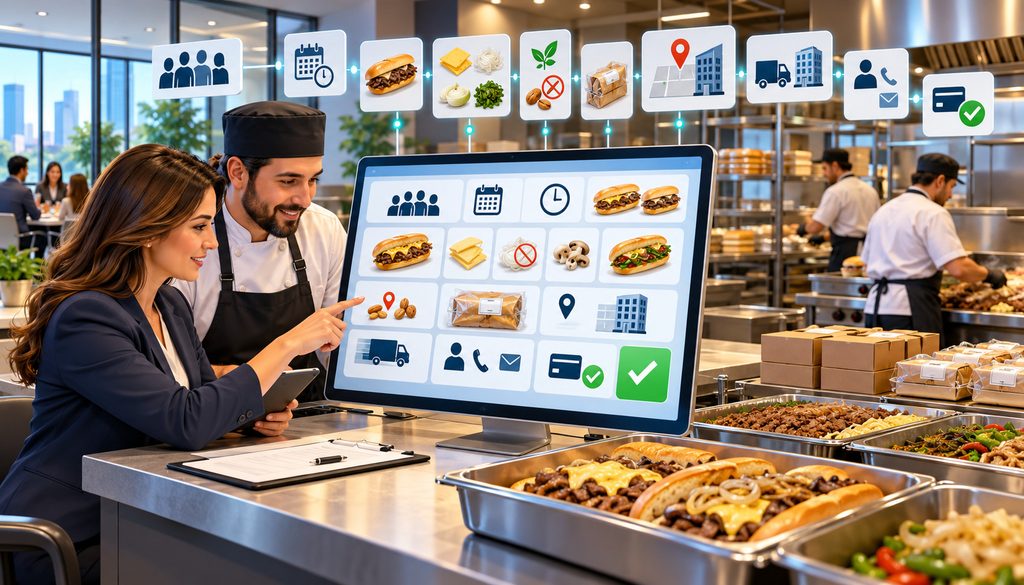
Final written confirmation is one of the most important parts of cheesesteak catering ordering.
A large order should not depend on two people remembering a telephone conversation the same way.
Confirm:
- Event date
- Serving time
- Pickup or delivery time
- Complete address
- Suite or floor
- Primary contact
- Backup contact
- Guest count
- Sandwich or tray quantities
- Cheese split
- Onion/no-onion counts
- Special requests
- Dietary notes
- Allergy information
- Vegetarian requests
- Sides
- Beverages
- Serving supplies
- Individual labeling
- Delivery details
- Setup details
- Subtotal
- Applicable taxes
- Applicable charges
- Deposit paid
- Remaining balance
- Due date
- Payment method
- Cancellation terms
- Confirmation number, if available
Read the order as though you are a kitchen employee who has never spoken to the organizer.
If a phrase such as “mixed cheeses” or “around noon” could be interpreted more than one way, replace it with a clear count or exact agreed time.
How to Change a Catering Order Without Creating Problems
Guest counts often change. Contact the restaurant as soon as there is a meaningful change rather than waiting until the last minute.
Use this workflow:
- Contact the restaurant promptly.
- Reference the original order.
- State exactly what is changing.
- Separate additions from removals.
- Ask whether preparation has started.
- Confirm the revised total.
- Ask whether the deposit or balance changes.
- Request updated written confirmation.
Increasing the Order
Additions are subject to capacity.
An extra ten meals may require more bread, meat, packaging, labels, and production time, particularly if the order is already scheduled during a busy period.
Decreasing the Order
Late reductions can also create problems because ingredients, labor, or packaging may already have been committed.
That is why change terms should be understood during the original cheesesteak catering ordering process.
How to Cancel Without Automatically Losing Your Deposit
Cancellation does not automatically guarantee either a refund or forfeiture. The result depends on the terms accepted for the order and how far the restaurant has progressed with purchasing and preparation.
Use this process:
- Contact the restaurant immediately.
- Use the same order reference or event details.
- Clearly state that the event is canceled.
- Ask whether preparation or dedicated purchasing has begun.
- Ask how the deposit or prepayment will be handled.
- Request an explanation of any retained amount.
- Ask whether rescheduling is possible if a refund is unavailable.
- Obtain written cancellation confirmation.
The best time to understand the cancellation terms is before making the payment.
A Practical Cheesesteak Catering Ordering Timeline
A useful cheesesteak catering ordering timeline works backward from the planned serving time.
As Early as Practical
- Estimate the guest count.
- Set the event date.
- Contact the restaurant.
- Ask about available catering formats.
- Discuss pickup or delivery.
- Identify dietary needs.
- Ask about deposit requirements.
After Receiving the Quote
- Review package yield.
- Confirm quantities.
- Finalize cheese counts.
- Finalize modifications.
- Review cancellation terms.
- Provide billing or PO information.
- Make any required payment.
- Obtain written confirmation.
Several Days Before the Event
- Update the headcount.
- Reconfirm dietary requests.
- Finalize labeled meals.
- Verify building access.
- Confirm the event-day contact.
- Provide parking or security details.
Day Before, Where Appropriate
- Verify the address.
- Verify suite or floor.
- Reconfirm the scheduled time.
- Prepare the receiving area.
Event Day
- Keep the contact phone available.
- Prepare the serving space.
- Meet the delivery or collect the order.
- Count trays or packages.
- Separate specially labeled meals.
- Follow provided serving or holding instructions.
These are planning steps, not mandatory restaurant deadlines.
Common Cheesesteak Catering Ordering Mistakes
| Common Mistake | Better Approach |
| Waiting until game day for a large order | Contact the restaurant early |
| Assuming every tray feeds the same number | Confirm the actual package yield |
| Sending only a headcount | Include timing, format, and fulfillment details |
| Saying “mixed cheese” | Give specific counts |
| Forgetting vegetarian meals | Count them separately |
| Mentioning allergies only at delivery | Discuss them before ordering |
| Assuming delivery includes setup | Confirm exactly what delivery includes |
| Assuming invoicing is automatic | Obtain billing approval first |
| Forgetting office security requirements | Include access instructions |
| Changing the count without confirmation | Obtain a revised order |
| Paying without checking cancellation terms | Review the terms first |
| Having nobody assigned to receive food | Name an event contact |
| Scheduling delivery too early | Coordinate arrival near serving time |
| Sending card details through ordinary email | Use the approved payment channel |
Sample Office Catering Scenario
Illustrative example only: A company is planning lunch for approximately 40 employees.
The organizer first confirms the expected attendance and planned serving time.
Next, the organizer compares shared trays with individually wrapped meals. Because several employees may be in separate meetings, individually wrapped meals might be easier to distribute, so the organizer asks whether that format is available.
Preferences are then converted into clear numbers. Cheese choices, onion preferences, vegetarian requests, and special meals are listed separately.
Any serious allergies are discussed directly before the order is approved. The organizer asks about ingredients and cross-contact instead of assuming that a label makes a meal allergen-free.
The request for a quote includes:
- Guest count
- Serving time
- Delivery or pickup preference
- Full office address
- Floor and suite
- Building-access instructions
- On-site contact
- Billing requirements
Before approving the order, the company confirms:
- Package yield
- Delivery availability
- Deposit or prepayment
- Cancellation terms
- Ability to adjust quantities
- Invoice or PO support
- Meal labeling
If the headcount changes later, the organizer contacts the restaurant and requests an updated written confirmation.
On event day, one employee is responsible for receiving the food, counting the packages, identifying special meals, and directing the order to the prepared serving area.
That is what reliable cheesesteak catering ordering looks like in practice: each important detail is confirmed before it turns into an assumption.
Catering Ordering Myths
| Myth | More Accurate Approach |
| “A catering tray always feeds a fixed number of people.” | Yield depends on sandwich size, sides, and serving format. |
| “I can place any large order the morning of the event.” | Kitchen capacity may already be committed. |
| “Delivery includes buffet setup.” | Setup should be confirmed separately. |
| “A card deposit means I can cancel anytime for a full refund.” | Refund treatment depends on the agreed cancellation terms. |
| “Corporate customers are automatically invoiced.” | Billing arrangements may require approval. |
| “Writing ‘allergy’ in a note guarantees an allergen-free meal.” | Ingredients and cross-contact should be discussed directly. |
| “A verbal change is enough.” | Large-order changes should be confirmed in writing. |
| “The street address is all the driver needs.” | Offices may require suite, security, parking, and contact information. |
Questions to Ask Before Finalizing a Cheesesteak Catering Order
Use this checklist before approving the order:
- What package sizes are currently available?
- What does each package include?
- How many people is each package intended to serve?
- Are sandwiches whole or cut?
- Can they be individually wrapped?
- Can meals be individually labeled?
- How far ahead should this order be placed?
- Is the requested date available?
- Is the requested serving time available?
- Is pickup available?
- Is delivery available to the address?
- Is there a delivery minimum?
- Are delivery charges applicable?
- Where does the handoff occur?
- Does delivery include setup?
- Are serving supplies included?
- Is warming equipment available?
- Can cheese choices be split?
- Can onion preferences be split?
- What vegetarian options are currently available?
- How should serious food allergies be communicated?
- What cross-contact information can the kitchen provide?
- Is a deposit required?
- How much is due now?
- When is the balance due?
- What is the cancellation policy?
- Is the deposit refundable?
- How late can quantities change?
- Is corporate invoicing available?
- Does invoicing require prior approval?
- Is a purchase order required?
- What information must appear on the PO?
- Who receives the invoice?
- What payment channel should be used?
- Who should be contacted if the event changes?
- Who is the event-day contact?
- Will written confirmation be provided?
FAQs
How far in advance should I order cheesesteak catering?
The right lead time depends on the order size, requested day, level of customization, delivery needs, and kitchen capacity. For cheesesteak catering ordering, contact the restaurant as early as practical for large groups, game days, or highly customized orders and get the requested date and time confirmed before finalizing event plans.
Can I order cheesesteak catering the day before an event?
Possibly. A smaller, straightforward next-day order may fit available production capacity, particularly if pickup works and modifications are limited. Larger orders, individual labeling, delivery, or peak demand can require more notice. Always confirm next-day availability directly.
Do large catering orders require a deposit?
They may. Restaurants can require a deposit, partial prepayment, full payment, or another form of authorization depending on the order. Before paying, confirm the amount due, final balance date, cancellation terms, and whether any deposit is refundable.
How many people does a cheesesteak tray feed?
Use the stated serving yield for the specific package. Sandwich size, cutting style, side dishes, guest appetite, event format, and whether other food is available can all affect how many people a tray actually serves.
Is pickup better than catering delivery?
Pickup gives the organizer more direct control over collection and can work well for nearby offices, but the customer must transport the order. Delivery is often more convenient for larger groups, although timing, access, handoff location, and any charges should be confirmed in advance.
Can I split the order between Whiz and provolone?
Ask whether both options are available for the specific order and provide exact counts. Clear quantities are easier for the kitchen to prepare and label accurately than a vague request such as “half and half.”
Can I order vegetarian meals with a cheesesteak catering order?
Ask which vegetarian options are currently available rather than assuming a particular item. If vegetarian meals are required, include the exact number during cheesesteak catering ordering and ask whether the meals can be labeled separately.
How should I communicate food allergies?
Tell the restaurant directly before finalizing the order. Ask about ingredients, shared equipment, preparation surfaces, and cross-contact procedures. An allergy note is useful, but it should not be treated as a guarantee that cross-contact can always be eliminated.
Can my company receive an invoice instead of paying by card?
Possibly. Corporate invoicing may require prior approval and additional billing information. Ask whether a PO is needed, when payment is due, who receives the invoice, and whether the invoice represents post-event credit or simply documents a prepaid order.
Can I change the number of guests after paying a deposit?
Request any change as early as possible. Additions depend on kitchen capacity, while reductions may affect the total or deposit if purchasing or preparation has already begun. Always request updated written confirmation.
What happens if I cancel a catering order?
The outcome depends on the cancellation terms agreed to for the order. Contact the restaurant promptly, ask how any deposit or prepayment will be handled, and obtain written confirmation of the cancellation.
Does catering delivery include setup?
Not necessarily. Delivery may mean a simple handoff, lobby drop-off, office-suite delivery, or something more involved. Ask where the food will be delivered and whether any setup, utensils, warming equipment, or serving assistance is included.
Make Cheesesteak Catering Ordering a Confirmed Process
Reliable cheesesteak catering ordering comes down to seven practical steps: know the guest count, choose the serving format, reserve early, document customizations, confirm pickup or delivery logistics, understand the payment and cancellation terms, and get the final order in writing.
A successful large order is not simply one with enough sandwiches. It is one that arrives at the right place and time, includes clearly identified special meals, matches the approved payment arrangement, and can be checked against the final confirmation.
Before committing, verify current package sizes, serving yields, availability, delivery coverage, customization options, payment requirements, deposit terms, invoice availability, setup scope, and cancellation rules for the specific event.